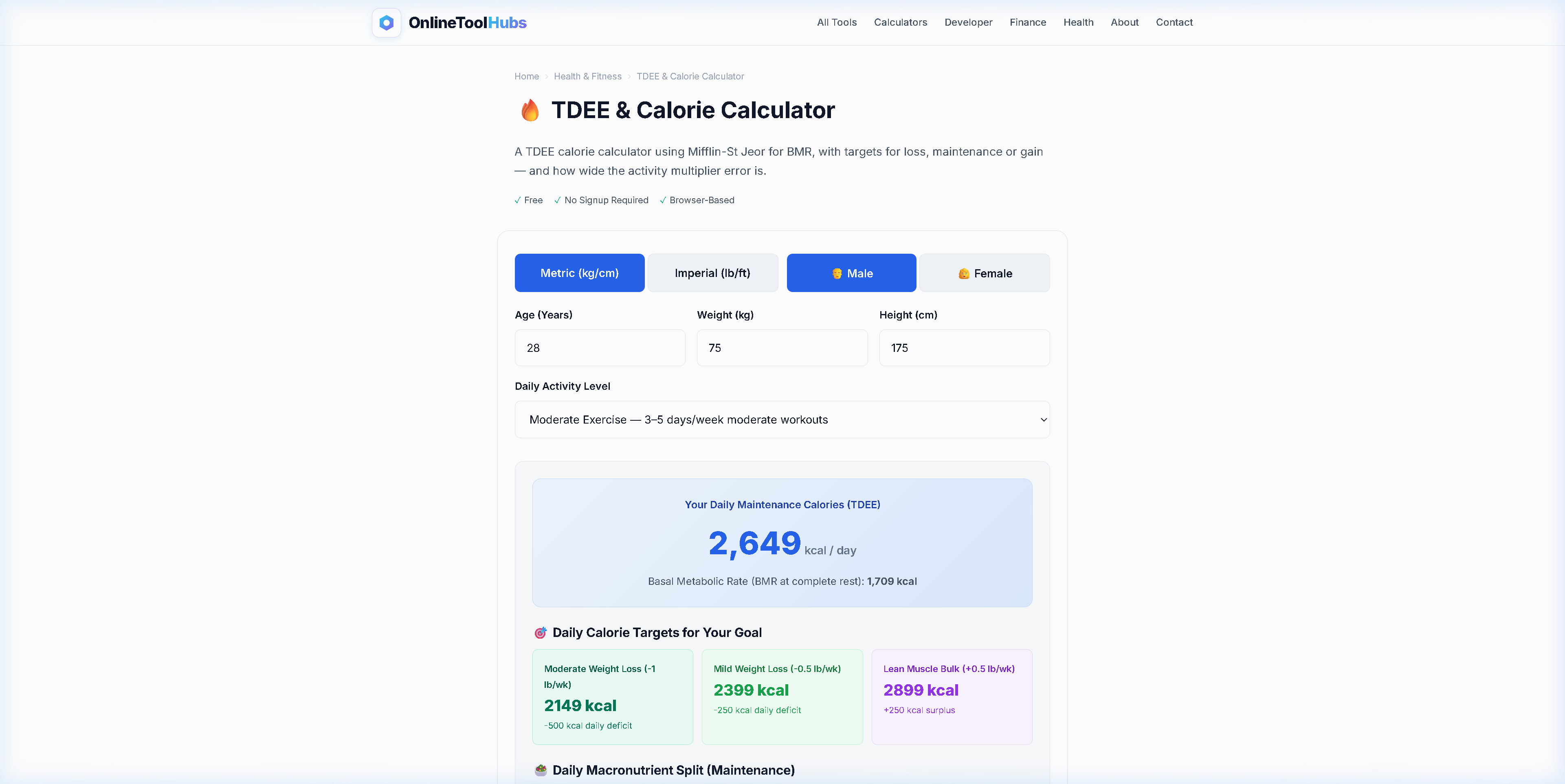
Every diet, fitness plan, and body composition goal starts with one number: how many calories your body actually burns per day. Without it you are guessing, and guessing leads to eating too little (causing muscle loss and metabolic slowdown) or eating too much (preventing fat loss).
Your TDEE (Total Daily Energy Expenditure) is the total number of calories your body burns in 24 hours. It includes everything from breathing and digestion to walking, exercising, and even thinking. The TDEE & Calorie Calculator on OnlineToolHubs uses the Mifflin-St Jeor equation, the most validated BMR formula in clinical research, and explains the activity multiplier.
What Is TDEE?
TDEE = BMR × Activity Multiplier
- BMR (Basal Metabolic Rate): The calories your body burns at absolute rest, just to keep your organs functioning, your heart beating, and your cells regenerating. This is your baseline.
- Activity Multiplier: A factor that accounts for all physical activity beyond lying still, from walking to your car to running a marathon.
The Mifflin-St Jeor BMR Formula
For men: BMR = (10 × weight in kg) + (6.25 × height in cm) - (5 × age in years) + 5
For women: BMR = (10 × weight in kg) + (6.25 × height in cm) - (5 × age in years) - 161
Activity Multipliers
| Activity Level | Multiplier | Description |
|---|---|---|
| Sedentary | 1.2 | Desk job, little or no exercise |
| Lightly active | 1.375 | Light exercise 1-3 days/week |
| Moderately active | 1.55 | Moderate exercise 3-5 days/week |
| Very active | 1.725 | Hard exercise 6-7 days/week |
| Extremely active | 1.9 | Very hard exercise, physical job, or training 2x/day |
How to Use the TDEE Calculator: Step-by-Step
Step 1: Enter Your Stats
Input your age, sex, height, and weight. The calculator accepts both metric (kg/cm) and imperial (lbs/feet+inches) units.
Step 2: Select Your Activity Level
Choose the activity level that best describes your typical week. Be honest, because overestimating activity is the most common mistake.
Step 3: Review Your Results
The calculator shows:
- BMR: your baseline calorie burn at rest
- TDEE: your total daily calorie burn
- Calorie targets: for weight loss (deficit), maintenance, and weight gain (surplus)
Calorie Targets for Different Goals
| Goal | Daily Calories | Rate of Change |
|---|---|---|
| Aggressive weight loss | TDEE - 750 to 1,000 | ~1.5-2 lbs/week |
| Moderate weight loss | TDEE - 500 | ~1 lb/week |
| Mild weight loss | TDEE - 250 | ~0.5 lb/week |
| Maintenance | TDEE | No change |
| Lean bulk / muscle gain | TDEE + 250 to 500 | ~0.5-1 lb/week |
Important: Never eat below your BMR for extended periods. This slows metabolism, causes muscle loss, and is unsustainable. For most people, a moderate deficit of 500 calories below TDEE is the most sustainable approach.
Example TDEE Calculation
Person: 30-year-old male, 180 cm (5’11”), 82 kg (180 lbs), moderately active
BMR = (10 × 82) + (6.25 × 180) - (5 × 30) + 5 = 820 + 1125 - 150 + 5 = 1,800 calories/day
TDEE = 1,800 × 1.55 (moderately active) = 2,790 calories/day
For weight loss (500 cal deficit): 2,290 calories/day For maintenance: 2,790 calories/day For muscle gain (300 cal surplus): 3,090 calories/day
Why Mifflin-St Jeor Instead of Harris-Benedict?
The Harris-Benedict equation (1919) was the standard for decades, but studies have shown it overestimates BMR by 5-15% for most modern populations. The Mifflin-St Jeor equation (1990) was developed with a more recent and representative sample, and multiple clinical studies have validated it as more accurate.
| Formula | Year | Accuracy | Notes |
|---|---|---|---|
| Harris-Benedict | 1919 | ±10-15% | Tends to overestimate |
| Mifflin-St Jeor | 1990 | ±10% | Most accurate for most people |
| Katch-McArdle | 1996 | ±10% | Requires body fat % (more precise for lean individuals) |
The OnlineToolHubs calculator uses Mifflin-St Jeor and states this clearly, so you know which formula is behind your result.
Common Mistakes When Using a TDEE Calculator
-
Overestimating activity level. If you work a desk job and exercise 3 times per week, you are “Lightly active,” not “Very active.” Most people overestimate by one full level.
-
Treating the result as exact. TDEE is an estimate, and your real number could be ±10% different. Use it as a starting point and adjust based on 2-3 weeks of real-world weight tracking.
-
Ignoring NEAT. Non-Exercise Activity Thermogenesis (fidgeting, walking, standing) accounts for 200-900 calories/day. It drops when you diet, which is why weight loss stalls.
-
Cutting calories too aggressively. Eating 1,200 calories when your TDEE is 2,800 is a 1,600-calorie deficit, which causes muscle loss, hormonal disruption, and rapid weight regain.
Related Health & Fitness Tools on OnlineToolHubs
| Tool | Purpose | Link |
|---|---|---|
| BMI Calculator | Calculate your Body Mass Index | BMI Calculator |
| Macro Calculator | Calculate protein, carb & fat targets | Macro Calculator |
| Body Fat Calculator | Estimate body fat percentage | Body Fat Calculator |
| Calorie Burn Calculator | Calories burned by activity | Calorie Burn |
| Ideal Body Weight | Calculate your IBW range | IBW Calculator |
| Water Intake Calculator | Daily water needs | Water Intake |
Try the TDEE Calculator Now: Free, No Signup Required
Stop guessing your calories. Use the most validated BMR formula in clinical research to calculate your daily calorie needs for weight loss, maintenance, or muscle gain.
Calculate Your TDEE Free on OnlineToolHubs. It uses the Mifflin-St Jeor equation, explains the activity multiplier, and needs no account.
Frequently Asked Questions
What is TDEE and how is it calculated?
TDEE is total daily calorie burn = BMR × activity multiplier. BMR is calculated using the Mifflin-St Jeor equation based on your age, sex, height, and weight.
How many calories should I eat to lose weight?
Eat 500 calories below your TDEE for approximately 1 pound of weight loss per week. Use the TDEE Calculator to find your number.
What is the difference between BMR and TDEE?
BMR is calories burned at complete rest. TDEE includes BMR plus all activity. TDEE is always higher.
Is the Mifflin-St Jeor equation accurate?
It is the most accurate widely-used BMR formula, with ±10% accuracy. Use it as a starting point and adjust based on real results.
This calculator gives estimates for general information. It isn't medical advice, so talk to a doctor or registered dietitian before making big changes to your diet. See our disclaimer.