
For successful founders, investors, and families, wealth accumulation is only half the story. The other, more complex half is its disposition: how to transfer not just assets, but values, across generations while making a meaningful impact on the world. This is where traditional charity falls short and Strategic Philanthropy begins.
Many high-net-worth individuals approach giving as a reactive, year-end tax exercise—a series of disconnected checks written to worthy causes. While commendable, this approach often fails to maximize impact, engage the family, or align with broader financial and estate planning goals. It’s an expense, not an investment.
Strategic philanthropy transforms giving from a simple transaction into a core component of your family’s legacy and financial architecture. It’s the practice of deploying your capital, time, and expertise to achieve specific, measurable social outcomes that resonate with your core values. It’s about creating a philanthropic portfolio as thoughtfully constructed as your investment portfolio, ensuring your wealth does more than just grow—it inspires.
This guide moves beyond the basics of charitable donations. We will explore how to integrate philanthropy directly into your wealth transfer strategies, creating a powerful engine for both social change and a cohesive family legacy. We’ll dissect the operational frameworks, financial vehicles, and governance models that turn good intentions into a lasting, multi-generational mission, drawing parallels with the discipline required for strategic estate planning and building a living legacy blueprint.
Table of Contents
Open Table of Contents
- Beyond the Checkbook: What is Strategic Philanthropy?
- The Legacy Impact Blueprint: A Framework for Generational Giving
- Architecting Your Impact: Choosing the Right Philanthropic Vehicles
- The Human Element: Governance and Succession Planning for Your Philanthropic Endeavors
- Maximizing Every Dollar: Tax-Efficient Charitable Giving for High Net Worth Individuals
- Beyond Donations: The Rise of Impact Investing
- Common Pitfalls in Philanthropy (And How to Avoid Them)
- Building Your Team: The Role of Philanthropic Advisory Services
- Conclusion: From Wealth Creation to Legacy Creation
Beyond the Checkbook: What is Strategic Philanthropy?
Strategic philanthropy is the disciplined, data-informed, and outcome-oriented approach to charitable giving. It reframes philanthropy from a passive act of generosity to an active investment in social change. Unlike conventional charity, which is often fragmented and emotionally driven, strategic philanthropy is defined by intentionality.
Think of it this way: a traditional charitable act might be donating to a local food bank during the holidays. A strategic philanthropic approach would involve researching the root causes of food insecurity in your community, identifying organizations with proven models for addressing those causes (e.g., job training, nutritional education, supply chain logistics), and providing multi-year funding tied to measurable outcomes, such as a reduction in the number of families requiring emergency food assistance.
The core tenets of strategic philanthropy include:
- Clear Goals: Defining what you want to achieve and how you will measure success. This moves beyond “doing good” to “achieving X outcome for Y population.”
- Due Diligence: Vetting organizations not just for financial health, but for leadership, operational effectiveness, and their ability to deliver on their mission.
- Long-Term Perspective: Often involving multi-year commitments rather than one-off donations, allowing organizations to plan and scale effectively.
- Alignment with Values: Ensuring your giving is a genuine reflection of your personal, family, or corporate values.
- Integration: Weaving philanthropic goals into your overall strategic financial planning for business growth and personal wealth management.
By adopting this mindset, you shift from being a mere donor to becoming a social investor, deploying capital to generate a specific, desired “social return.”

The Legacy Impact Blueprint: A Framework for Generational Giving
To move from concept to execution, a structured framework is essential. We call this The Legacy Impact Blueprint. It’s a four-stage process designed to build a durable, effective, and meaningful philanthropic strategy that integrates seamlessly with your wealth transfer objectives.
Stage 1: Clarify Core Values & Define Your Mission
Before any financial vehicle is chosen or a dollar is donated, the process must begin with introspection. This is the foundation upon which the entire structure rests.
- Identify Your “Why”: What issues do you and your family care about most deeply? Education, environmental conservation, medical research, arts and culture?
- Define Your Geographic Focus: Do you want to impact your local community, your nation, or the world?
- Determine Your Approach: Do you want to fund direct services (e.g., feeding the hungry), or do you prefer to invest in systemic change (e.g., funding policy research to address the root causes of hunger)?
- Draft a Philanthropic Mission Statement: In one or two sentences, articulate your purpose. For example: “Our family’s mission is to advance educational equity for underserved students in our home state by investing in innovative K-12 programs and teacher development.” This statement becomes your North Star.
Stage 2: Architect the Financial Structure
With a clear mission, you can now select the optimal tools for the job. This isn’t just about tax efficiency; it’s about matching the vehicle’s capabilities (control, anonymity, cost, complexity) to your goals.
- Assess Your Desired Level of Involvement: Do you want to be hands-on or delegate grantmaking?
- Evaluate Your Financial Capacity: What level of capital are you prepared to commit, both now and in the future?
- Analyze the Trade-Offs: Consider factors like administrative burden, privacy, and flexibility for each option (e.g., Donor-Advised Funds vs. Private Foundations).
Stage 3: Govern for Generations
A structure without a governance plan is destined for conflict or mission drift. This stage is critical for multi-generational success.
- Establish Roles & Responsibilities: Who makes decisions? Will there be a board? What role will younger family members play?
- Create a Grantmaking Process: How will you source and evaluate potential grantees? What are your criteria for funding?
- Develop a Succession Plan: Who will lead the philanthropic efforts in the next generation? How will they be trained and prepared? This is a key part of any comprehensive succession planning for philanthropic endeavors.
Stage 4: Measure, Learn, and Adapt
Strategic philanthropy is not static. It requires a commitment to learning and evolution.
- Set Key Performance Indicators (KPIs): Beyond dollars deployed, what metrics will signal success? (e.g., number of students graduated, acres of land conserved).
- Conduct Regular Reviews: Annually assess your strategy, your grantees’ performance, and your overall impact against your mission.
- Embrace Flexibility: The world changes, and your philanthropic strategy should be agile enough to adapt to new challenges and opportunities.
Architecting Your Impact: Choosing the Right Philanthropic Vehicles
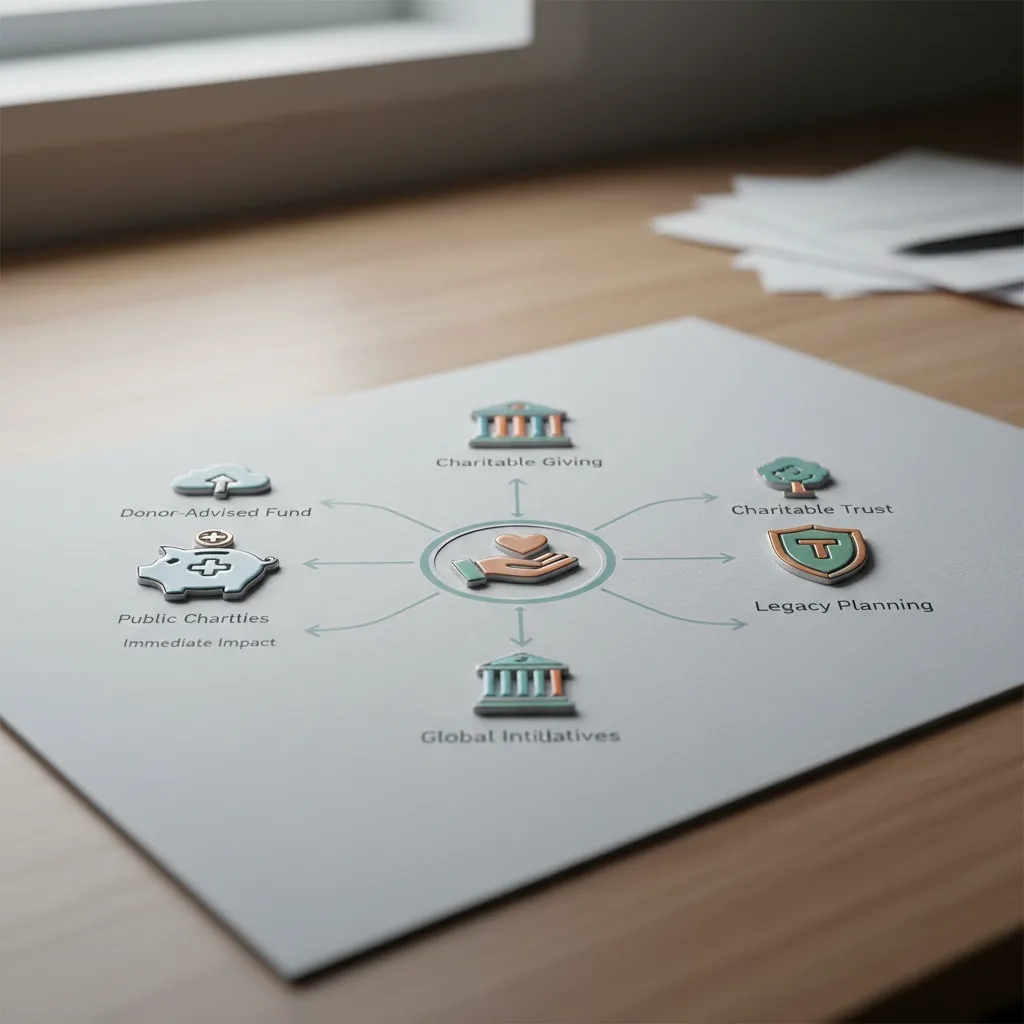
The vehicle you choose to house your charitable assets has profound implications for your strategy’s cost, control, and complexity. The three most common structures for high-net-worth families are Donor-Advised Funds, Private Foundations, and Charitable Trusts.
Donor-Advised Funds (DAFs): The Agile Approach
A DAF is a charitable giving account established at a public charity, often called a sponsoring organization (e.g., Fidelity Charitable, Schwab Charitable, or a local community foundation). You contribute cash, securities, or other assets, receive an immediate maximum tax deduction, and the assets grow tax-free. You can then recommend grants to qualified non-profits over time.
- Pros: Simple to set up, low administrative burden, potential for anonymity, immediate tax benefit.
- Cons: Less control over investments, grants can only be made to registered charities (no direct support for individuals), you are technically “recommending” grants, not directing them.
- Best For: Individuals and families who want a simple, tax-efficient way to manage their giving without the administrative complexity of a private foundation.
Private Foundations: The Hands-On Legacy Builder
A private foundation is an independent legal entity created solely for charitable purposes. The family typically controls it, managing its investments and grantmaking decisions directly through a board of directors or trustees.
- Pros: Maximum control over investments and grantmaking, ability to hire staff, can make grants to a wider range of recipients (including individuals, with IRS approval), serves as a powerful platform for a family’s identity and legacy.
- Cons: Significant administrative complexity and cost, lower tax deductibility limits than DAFs, strict regulatory oversight, and an annual minimum distribution requirement (typically 5% of assets).
- Best For: Families with significant assets to commit ($5M+ is a common guideline) who desire deep involvement, control, and a multi-generational platform for their philanthropy.
Charitable Trusts: The Integrated Financial Tool
Charitable Remainder Trusts (CRTs) and Charitable Lead Trusts (CLTs) are powerful estate-planning tools that blend philanthropy with financial benefits for the donor or their heirs.
-
Charitable Remainder Trust (CRT): You place assets in a trust, which pays an income stream to you or your beneficiaries for a set term. At the end of the term, the remaining assets (“remainder”) go to a designated charity. This is often used to sell a highly appreciated asset while deferring capital gains tax.
-
Charitable Lead Trust (CLT): This is the inverse of a CRT. The trust first makes payments to a charity for a set term, and the remainder then passes to your heirs, often with significant gift or estate tax savings.
-
Pros: Highly effective for tax and estate planning, particularly with appreciated assets.
-
Cons: Irrevocable and complex to establish, requiring expert legal and financial advice.
Comparison: Donor-Advised Funds vs. Private Foundations
| Feature | Donor-Advised Fund (DAF) | Private Foundation |
|---|---|---|
| Setup Time & Cost | Low (hours, minimal cost) | High (weeks/months, significant legal fees) |
| Control | Recommend grants, limited investment control | Full control over grants and investments |
| Anonymity | High (can grant anonymously) | Low (publicly disclosed) |
| Administration | Handled by sponsoring organization | Managed by family/staff |
| Tax Deductibility | Higher limits (e.g., up to 60% of AGI for cash) | Lower limits (e.g., up to 30% of AGI for cash) |
| Minimum Payout | None required | 5% of assets annually |
| Best For | Simplicity, tax efficiency, ease of use | Control, legacy building, significant assets |
The Human Element: Governance and Succession Planning for Your Philanthropic Endeavors
The most common point of failure in multi-generational philanthropy isn’t financial—it’s human. Without a clear governance structure and a plan for succession, a family’s philanthropic mission can easily dissolve into confusion, conflict, or apathy.
Crafting Your Family’s Philanthropic Mission Statement
As mentioned in the Blueprint, a mission statement is non-negotiable. It serves as the constitution for your family’s giving. An effective process for creating one involves:
- Individual Reflection: Each family member involved writes down their personal values and charitable interests.
- Group Discussion: A facilitated meeting (often led by a philanthropic advisor) helps identify overlapping themes and shared passions.
- Drafting & Refining: Collaboratively write a concise statement that captures the family’s collective vision.
Involving the Next Generation: From Allowance to Board Seat
Engaging younger family members early and meaningfully is the only way to ensure continuity.
- Start Early: Introduce the concept of giving through a “give/save/spend” allowance model.
- Create Junior Boards: For larger foundations, a junior board can be given a small budget to manage. This provides hands-on grantmaking experience in a lower-stakes environment.
- Site Visits & Volunteering: Move beyond check-writing to connect the next generation directly with the organizations and causes you support.
- Formal Training: Provide education on financial literacy, non-profit analysis, and board governance.
The Philanthropic Succession Plan: Avoiding Mission Drift
A succession plan explicitly outlines how leadership and decision-making will transition over time. It should address key questions:
- Who is eligible to participate on the board or advisory committee? (e.g., direct descendants, spouses)
- What are the qualifications and term limits for leadership roles?
- How will new members be onboarded and educated on the family’s philanthropic history and mission?
- What is the process for amending the mission statement or changing strategic direction?
Maximizing Every Dollar: Tax-Efficient Charitable Giving for High Net Worth Individuals
Strategic philanthropy is not just about impact; it’s also about optimizing your financial resources to increase that impact. Tax-efficient giving strategies allow you to give more at a lower net cost to you.
- Donating Appreciated Securities: This is often the most tax-savvy way to give. By donating stock or mutual funds held for more than a year, you can generally deduct the full fair market value and avoid paying capital gains tax on the appreciation. This “double benefit” is a cornerstone of strategic tax-efficient investing and wealth growth.
- Bunching Contributions: With higher standard deductions, some taxpayers may not be able to itemize deductions every year. “Bunching” involves consolidating several years’ worth of charitable contributions into a single year (often into a DAF), allowing you to exceed the standard deduction in that year while maintaining your regular giving schedule from the DAF in subsequent years.
- Qualified Charitable Distributions (QCDs): Individuals over age 70½ can donate up to $100,000 per year directly from their IRA to a qualified charity. The distribution is not counted as taxable income and can satisfy part or all of your Required Minimum Distribution (RMD).
- Donating Complex Assets: Real estate, restricted stock, or private business interests (S-corp or LLC shares) can be powerful assets for philanthropy, but require careful planning with legal and tax advisors to navigate the complex valuation and transfer rules.
Beyond Donations: The Rise of Impact Investing
A truly integrated philanthropic strategy looks beyond the grantmaking budget to the entire balance sheet. Impact investing involves making investments in companies, organizations, and funds with the intention to generate a measurable, beneficial social or environmental impact alongside a financial return.
This approach blurs the lines between philanthropy and investment, allowing you to activate your entire portfolio in service of your mission. For example, a foundation focused on climate change could invest a portion of its endowment in renewable energy startups or green bonds. This aligns the investment capital with the philanthropic mission, creating a powerful synergy. It’s a practical application of principles found in strategic ESG investing for ethical returns.
Common Pitfalls in Philanthropy (And How to Avoid Them)
Even the most well-intentioned philanthropic efforts can stumble. Awareness of these common failure patterns is the first step to avoiding them.
- The “Ego” Trap: Funding projects that are more about personal recognition (e.g., a named building) than about addressing a critical community need.
- Solution: Anchor every decision in your mission statement and objective due diligence.
- The “Starvation Cycle”: Earmarking donations strictly for programs while refusing to fund overhead or operational costs. This cripples an organization’s ability to invest in talent, technology, and infrastructure.
- Solution: Provide unrestricted funding to high-performing organizations you trust.
- Lack of Due Diligence: Funding an organization based on a compelling story without vetting its leadership, financial health, or evidence of impact.
- Solution: Implement a consistent, rigorous evaluation process for all potential grantees.
- Failure to Engage Family: One or two family members making all decisions, leading to disinterest or resentment from the next generation.
- Solution: Proactively create inclusive governance structures and engagement opportunities.
Building Your Team: The Role of Philanthropic Advisory Services
Navigating the complexities of strategic philanthropy is not a solo endeavor. Building a team of trusted advisors is crucial for success.
- Wealth Managers/Financial Advisors: Help integrate philanthropic planning with your overall financial picture, especially regarding tax-efficient giving strategies. A fiduciary financial advisor provides unbiased advice that is in your best interest.
- Estate Planning Attorneys: Draft the legal documents for trusts, foundations, and other complex giving vehicles.
- Accountants (CPAs): Provide guidance on tax implications and ensure compliance with all IRS regulations.
- Philanthropic Advisors: Specialized consultants who can facilitate family meetings, help define your mission, conduct due diligence on non-profits, and measure the impact of your giving.
Conclusion: From Wealth Creation to Legacy Creation
Strategic philanthropy is the ultimate bridge between financial success and personal significance. It transforms wealth from a simple measure of net worth into a dynamic tool for expressing values, solving problems, and uniting a family across generations.
By moving beyond reactive charity to a disciplined, intentional, and integrated approach, you are not just giving money away; you are investing in the future you wish to see. The Legacy Impact Blueprint provides a clear path to architect a philanthropic strategy that is as sophisticated and effective as the business or investment strategies that created your wealth. It ensures that your legacy is defined not by what you owned, but by the lasting, positive change you created.
Built for readers, sustained by readers. Crypto donations help fund deeper research and independent analysis.
BTC: 1 Trendy111111111111111111111111111111
ETH: 0xTrend1111111111111111111111111111111111