
The digital perimeter is gone. For decades, enterprises operated on a “castle-and-moat” security model: a hardened perimeter with a trusted network inside and an untrusted world outside. But the relentless shift to cloud computing, the explosion of SaaS applications, a distributed workforce, and increasingly sophisticated cyber threats have rendered this approach obsolete. The moat has been bridged, and the castle walls are full of holes.
In this new reality, trust is a vulnerability. A single compromised credential or a vulnerable endpoint can give an attacker free rein inside a supposedly “trusted” network. This is the critical challenge that the Zero Trust Security Model was designed to solve. It’s a fundamental paradigm shift in cybersecurity, moving from a location-centric model to an identity-centric one. The core principle is simple yet profound: never trust, always verify.
This isn’t just another IT project or a product you can buy off the shelf. Adopting Zero Trust is a strategic imperative that aligns security with business outcomes. It’s a journey towards building a more resilient, agile, and competitive enterprise. By embedding security into the very fabric of your operations, you can accelerate innovation, ensure compliance, and protect your most valuable assets. For a holistic view of modern security, understanding SaaS security best practices for the enterprise is a critical starting point.
Table of Contents
Open Table of Contents
- The End of an Era: Why Traditional Security No Longer Works
- Deconstructing the Zero Trust Security Model: The Three Core Principles
- Beyond Defense: The Strategic Business Benefits of Zero Trust
- A Practical Roadmap: Implementing a Zero Trust Architecture
- The Modern Zero Trust Tech Stack: Key Capabilities
- Common Pitfalls in Zero Trust Implementation (And How to Avoid Them)
- Conclusion: Zero Trust is a Continuous Journey, Not a Destination
The End of an Era: Why Traditional Security No Longer Works
For years, the formula for enterprise security was straightforward: build a strong perimeter with firewalls, intrusion detection systems, and secure web gateways. To grant remote access, you deployed a Virtual Private Network (VPN), creating an encrypted tunnel that extended the “trusted” corporate network to the user’s device. Once inside that trusted zone, users and devices were often granted broad access.
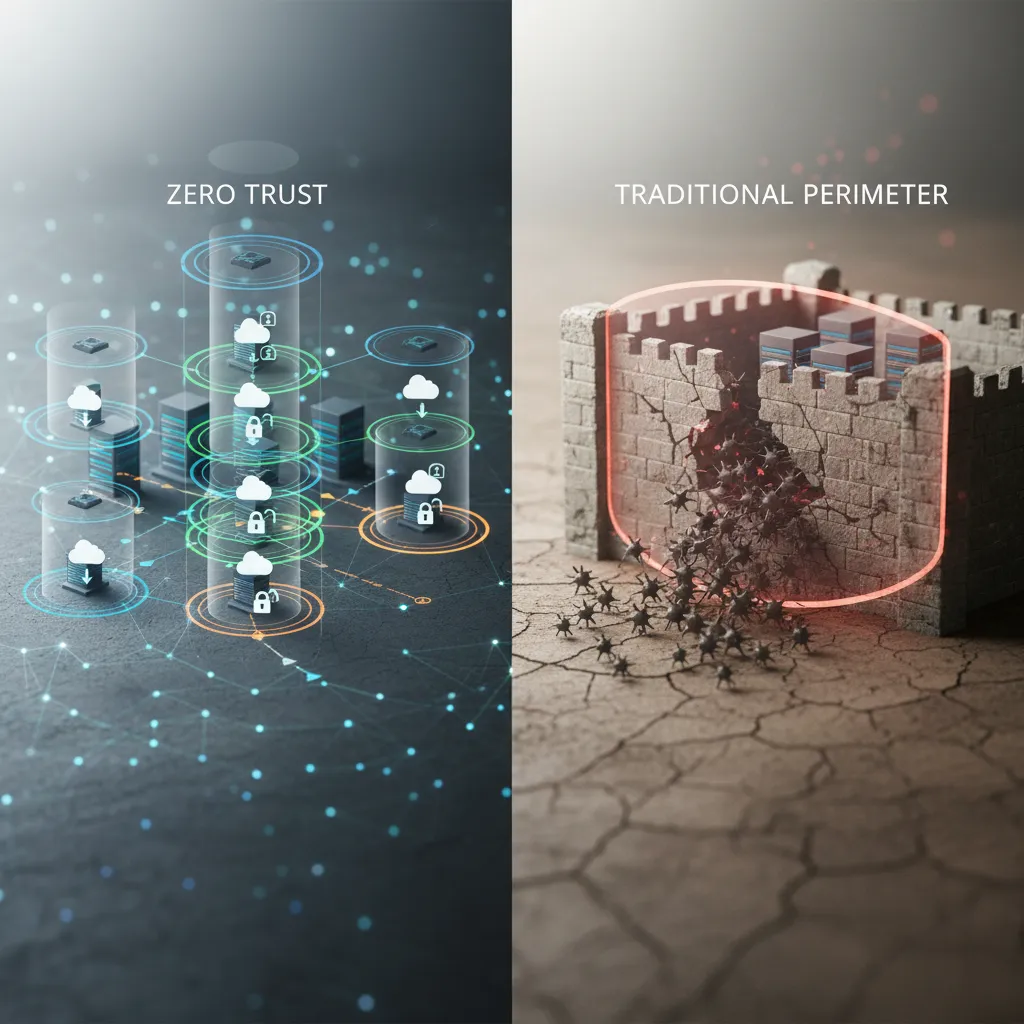
This model crumbles under the weight of modern IT complexity:
- Distributed Workforce: Employees, contractors, and partners access corporate resources from anywhere in the world, on any device, often over unsecured networks. The “office” is no longer the perimeter.
- Cloud & SaaS Adoption: Critical data and applications are no longer confined to on-premise data centers. They reside in public clouds, private clouds, and hundreds of SaaS applications, creating a vast, fragmented attack surface. A multi-cloud strategy further complicates this landscape.
- Sophisticated Threats: Attackers are no longer just trying to breach the perimeter. They use phishing, social engineering, and stolen credentials to land inside the network, where they can move laterally undetected for weeks or months.
- The VPN Bottleneck: Traditional VPNs are often clunky, slow, and provide overly permissive access. Once a user is connected via VPN, they are effectively “on the network,” creating a significant security risk if their device or credentials are compromised. The Zero Trust vs VPN debate ends here; VPNs grant access to a network, whereas Zero Trust grants access to specific resources.
The fundamental flaw of the perimeter model is its binary trust decision. It asks, “Are you on my network?” If the answer is yes, a high level of trust is granted. Zero Trust asks a much more intelligent set of questions: “Who are you? What device are you using? Is it secure? What resource are you trying to access? Does your role permit this? Is your behavior normal?” This continuous, context-aware verification is the heart of the new model.
Deconstructing the Zero Trust Security Model: The Three Core Principles
Zero Trust is not a single technology but a strategic framework built on guiding principles. While different models exist (like those from NIST or Forrester), they all revolve around three fundamental pillars. Understanding these zero trust principles is the first step toward successful adoption.
1. Verify Explicitly
This is the cornerstone of Zero Trust. Every single access request must be treated as if it originates from an untrusted network. Authentication and authorization must be dynamically and explicitly verified before access is granted, based on every available data point, including:
- User Identity: Who is the user? Is their identity verified with strong authentication, like Multi-Factor Authentication (MFA)?
- Device Health: What device are they using? Is it a managed corporate asset? Is its security posture (patch level, endpoint protection status) compliant?
- Location: Where is the request coming from? Is it a typical location for this user, or is it anomalous?
- Service & Application: What specific resource is being requested?
- Data Sensitivity: How sensitive is the data being accessed?
This principle dismantles the idea of a “trusted” internal user. An executive’s laptop in the office boardroom is treated with the same initial skepticism as a developer’s personal tablet in a coffee shop.
2. Use Least Privilege Access
Once a user or device is verified, they should only be granted the minimum level of access required to perform their specific task. This is the principle of least privilege, applied with surgical precision. It includes two key concepts:
- Just-Enough-Access (JEA): Users only get access to the applications and data segments they absolutely need. A marketing manager doesn’t need access to the source code repository, and an engineer doesn’t need access to the HR payroll system.
- Just-in-Time (JIT) Access: Access is granted for a limited time, only for the duration of the task. Privileged access, in particular, should be ephemeral, expiring automatically after a session.
By enforcing least privilege, you dramatically reduce the “blast radius” of a potential breach. If an attacker compromises an account, their ability to move laterally and access other systems is severely restricted.
3. Assume Breach
This principle forces a shift in mindset from breach prevention to breach containment. You must operate under the assumption that an attacker is already inside your network. This doesn’t mean giving up on prevention, but rather designing your architecture to be resilient in the face of a compromise. Key tactics include:
- Micro-segmentation: Break down your network into small, isolated zones or segments. You can create segments around applications, environments (dev, staging, prod), or data sensitivity levels. Security policies then control traffic between these segments, preventing an attacker from moving freely from a less-critical system to a high-value one.
- End-to-End Encryption: All traffic must be encrypted, not just at the perimeter but also internally between services and applications (“east-west” traffic).
- Continuous Monitoring: Use advanced analytics and AI to monitor all network traffic and user behavior for signs of compromise, enabling you to detect and respond to threats in near real-time. Effective cloud security posture management is a vital component of this.
Beyond Defense: The Strategic Business Benefits of Zero Trust
While the security enhancements are clear, the true power of an enterprise security strategy built on Zero Trust lies in its ability to enable the business. When implemented correctly, it’s not a blocker but an accelerator.

- Improved Business Agility: Zero Trust decouples security from network location, allowing you to securely connect any user, on any device, to any application, anywhere. This empowers secure remote work, safe collaboration with partners, and rapid integration of M&A targets.
- Reduced Complexity and Cost: By centralizing policy management and moving away from complex legacy network architectures, organizations can often reduce their operational overhead. This aligns with broader goals like cloud cost optimization.
- Streamlined Compliance and Governance: Zero Trust provides granular visibility and control over who is accessing what data and why. This makes it far easier to enforce policies and generate the audit trails needed to demonstrate compliance with regulations like GDPR, HIPAA, and PCI DSS. Robust cloud data governance becomes an achievable reality.
- Enhanced User Experience: Modern Zero Trust solutions, particularly Zero Trust Network Access (ZTNA), can provide a seamless and faster user experience compared to traditional VPNs. Users get direct, secure access to the applications they need without having to log in to a clunky VPN client that backhauls all their traffic through a central data center.
- Future-Proofs Your Architecture: A Zero Trust architecture is inherently more adaptable to future technologies and business needs, from IoT and edge computing to further cloud expansion.
A Practical Roadmap: Implementing a Zero Trust Architecture
Transitioning to Zero Trust is a multi-year journey, not an overnight flip of a switch. It requires a phased, strategic approach focused on incremental wins. Here are the essential steps for implementing zero trust architecture.
Step 1: Define Your Protect Surface
You can’t protect what you don’t understand. The first step is to identify your most critical and valuable assets. This isn’t about your entire network; it’s about the specific Data, Applications, Assets, and Services (DAAS) that are most crucial to your business operations. Your protect surface could be a customer database, your intellectual property, your payment processing system, or your Active Directory domain controllers.
Step 2: Map the Transaction Flows
Once you’ve identified the protect surface, you need to understand how users and applications interact with it. Map out the legitimate traffic flows to and from these critical assets. Who needs to access this data? From where? Which applications communicate with each other? This visibility is crucial for designing effective security policies.
Step 3: Architect Your Zero Trust Network
With a clear understanding of your protect surface and its traffic flows, you can begin to design the architecture. The key technology here is micro-segmentation. You can use next-generation firewalls or software-defined networking to create a “policy-defined perimeter” directly around your protect surface. This essentially creates a secure, isolated bubble around your most valuable assets.
Step 4: Create and Enforce Zero Trust Policies
Now, you codify the rules. Using the “Kipling Method” (Who, What, When, Where, Why, and How), you create granular policies that define access.
- Who is allowed to access the resource? (Based on identity and role)
- What application are they using to access it?
- When can they access it? (e.g., during business hours)
- Where is the user connecting from? (Device and geographic location)
- Why is the resource being accessed? (Context from the application)
- How is it being accessed? (With what device posture and authentication strength)
These policies are then enforced by your segmentation gateway or policy engine.
Step 5: Monitor, Maintain, and Mature
Zero Trust is not a “set it and forget it” project. You must continuously monitor all traffic, logging and inspecting everything to look for suspicious activity. Use security analytics to refine your policies, expand your protect surfaces, and mature your implementation over time. This continuous feedback loop is what makes the model resilient and adaptive.
The Modern Zero Trust Tech Stack: Key Capabilities
While it’s a strategic framework, Zero Trust is enabled by a set of integrated technologies. A mature implementation will leverage several key components:
- Identity and Access Management (IAM): This is the core of Zero Trust. A strong identity provider (IdP) coupled with Single Sign-On (SSO) and robust Multi-Factor Authentication (MFA) is non-negotiable.
- Endpoint Detection and Response (EDR): Every device is a potential entry point. EDR solutions continuously monitor endpoints to detect and respond to threats, providing critical signals about device health to the policy engine.
- Zero Trust Network Access (ZTNA): This is the modern successor to the VPN. ZTNA solutions provide secure, application-level access to specific resources without granting broad network access. They connect a user to an application, not a network.
- Micro-segmentation Platforms: These can be next-generation firewalls (NGFWs) or software-defined solutions that allow you to enforce granular controls between workloads, both on-premise and in the cloud.
- Security Information and Event Management (SIEM) & Security Orchestration, Automation, and Response (SOAR): These platforms aggregate logs and telemetry from across your entire environment, using analytics and AI to detect complex threats and automate response actions.
Common Pitfalls in Zero Trust Implementation (And How to Avoid Them)
The road to Zero Trust can be challenging. Many organizations stumble by making these common mistakes:
- Mistake #1: A “Big Bang” Rollout: Trying to implement Zero Trust across the entire organization at once is a recipe for failure. Best practice dictates starting with a single, high-impact use case, like protecting a critical application or securing a specific group of remote users. Learn from this initial project and expand incrementally.
- Mistake #2: Focusing Only on Technology: Buying the latest ZTNA tool without a strategic plan is a waste of money. Zero Trust is a change in culture and process first, supported by technology second. It requires buy-in from leadership and collaboration across IT, security, and business units.
- Mistake #3: Neglecting the User Experience: If your new security controls are too complex or restrictive, users will find ways to bypass them, creating new security gaps. The goal is to make security invisible and seamless wherever possible.
- Mistake #4: Poor Visibility: You cannot enforce a policy on traffic you can’t see. Before applying controls, ensure you have comprehensive visibility into your network traffic, application dependencies, and user activity.
Conclusion: Zero Trust is a Continuous Journey, Not a Destination
Adopting a Zero Trust Security Model is no longer an option for the modern enterprise; it is an essential strategic evolution. The legacy model of perimeter-based security is fundamentally broken, leaving organizations exposed to unacceptable levels of risk in an era of distributed work and cloud-native infrastructure.
By embracing the core principles—verify explicitly, use least privilege access, and assume breach—you shift from a reactive security posture to a proactive and resilient one. This transformation is not merely about preventing breaches; it is about building a secure foundation that enables business agility, accelerates digital initiatives, and fosters a culture of security by design.
The path to a mature Zero Trust architecture is a marathon, not a sprint. It requires commitment, strategic planning, and a phased approach. But the payoff is immense: a security framework that is not a barrier to innovation but a catalyst for it, providing the confidence to operate securely and competitively in a world without perimeters.